


Light-Matter Interactions Beyond the Dipole Approximation in Extended Systems Without Multipole Expansion
R Dora, R Korol, V Tiwari, R Chourasiya and I Franco*,
arXiv 2026
, 10.48550/arXiv.2603.10271.
×
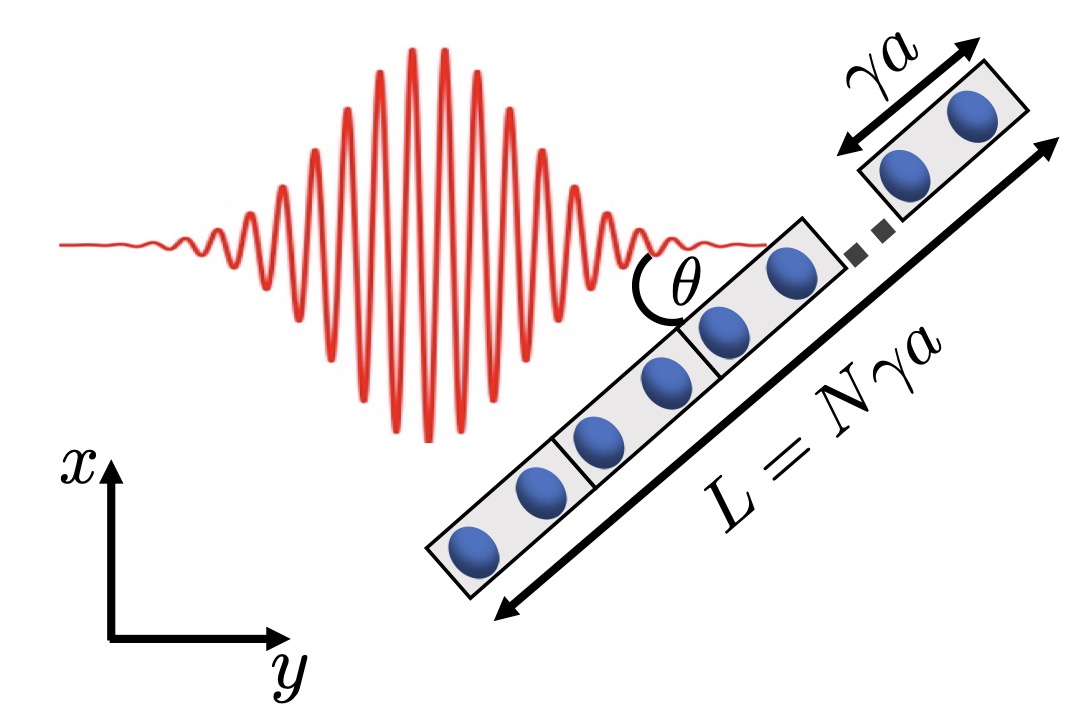
The standard "dipole approximation" used to model how light interacts with materials can break down for materials larger than the wavelength of light or under non-uniform illumination. We present a computational framework, based on first-principles electronic structure and localized Wannier functions, that captures these "beyond-dipole" effects at essentially the same computational cost as a standard calculation. We find the usual approximation works well for thin, uniformly-lit 1-D and 2-D materials, but breaks down for 3-D materials, oblique illumination, or partial lighting—cases increasingly relevant for nanoscale devices and quantum materials.